Blue Delft Watercolor Floral Elements: A Comprehensive Guide to Authentic Dutch Design
The enduring legacy of Dutch ceramics has long captivated artists, designers, and historians alike. At the heart of this tradition lies a distinct aesthetic defined by its striking contrast between crisp white backgrounds and deep cobalt blue motifs. The Blue Delft Watercolor Floral Elements collection brings this historical artistry into the modern digital age, offering a versatile suite of assets that bridge the gap between 17th-century craftsmanship and contemporary creative workflows. By digitizing the essence of hand-painted Holland ceramics, this collection provides creators with the tools necessary to infuse their projects with a sense of heritage, elegance, and timeless beauty.
The Artistic Heritage Behind the Collection
To truly appreciate the value of these digital assets, one must understand the origins of the design language they represent. The style known as Delft Blue emerged in the Netherlands during the 17th century, heavily influenced by the importation of Chinese porcelain. Local potters in Delft sought to replicate the coveted blue-and-white wares from the East, eventually developing a unique style that became synonymous with Dutch identity. The hallmark of this style is the use of cobalt oxide, which produces a rich, vibrant blue that remains stable under high heat.
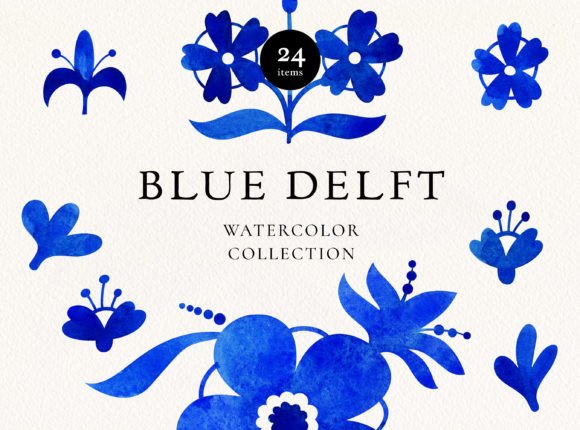
This specific collection captures that spirit through watercolor techniques. Unlike rigid vector graphics, watercolor introduces organic textures, soft edges, and subtle variations in pigment density. The Blue Delft collection contains 24 high-quality watercolor images featuring flowers, twigs, leaves, and blossoms. These elements are not merely copies of old patterns; they are reinterpretations inspired by the cobalt patterns found on authentic hand-painted ceramics. This approach ensures that while the imagery feels historically grounded, it retains the fluidity and charm required for modern design applications.
Technical Specifications and Quality Standards
In the realm of professional design, the technical integrity of an asset is just as critical as its aesthetic appeal. Every file within this set is prepared to meet rigorous industry standards. All files are delivered in PNG format with transparent backgrounds, allowing for seamless integration into complex layouts without unsightly white boxes or background noise. The color space is set to RGB, making them ideal for both digital screens and print production where color management is handled appropriately.
Furthermore, the resolution of each element is optimized for high-definition output. With a standard of 300 dpi, these images are sharp enough for large-format printing, ensuring that fine details in the petals and leaf veins remain crisp even when scaled up. The collection includes a diverse range of sizes to suit various needs:
- Large Flower Images: Three substantial pieces measuring approximately 2500 × 3300 pixels, perfect for focal points in posters or large-scale branding materials.
- Twig Elements: Four detailed twig images at 2000 × 2000 pixels, providing structural balance and organic framing capabilities.
- Leaf Details: Eight individual leaf images sized at 700 × 700 pixels, ideal for texture overlays or decorative accents.
- Blossom Clusters: Eight blossom images also at 700 × 700 pixels, offering delicate floral touches for softer design contexts.
- Decorative Bar: One expansive bar image measuring 6022 × 653 pixels, designed specifically for headers, dividers, or wrapping text.
Practical Applications Across Industries
The versatility of the Blue Delft Watercolor Floral Elements extends far beyond simple decoration. Their unique blend of traditional aesthetics and digital utility makes them suitable for a wide array of industries. Whether you are a brand manager looking to establish a sophisticated visual identity or a hobbyist creating personalized gifts, these assets offer significant advantages.
Branding and Corporate Identity
In the competitive landscape of business, standing out requires a strong visual narrative. Brands that wish to convey trust, heritage, and quality often look to historical styles for inspiration. Incorporating the Blue Delft collection into a logo system or brand guidelines can instantly communicate a sense of established reliability. The cobalt blue palette is psychologically associated with intelligence, stability, and communication, making it an excellent choice for financial institutions, law firms, or educational organizations that want to appear approachable yet authoritative.
The included decorative bar is particularly useful for website headers, email signatures, or presentation slides. It serves as a unifying element that ties disparate content together, creating a cohesive look across all touchpoints. For businesses focusing on sustainability or artisanal products, the watercolor texture adds a human touch that mass-produced vector graphics often lack.
Textile Design and Fashion
Fashion and textile designers have long relied on floral motifs to create seasonal collections. The organic nature of watercolor painting allows for infinite pattern possibilities. Designers can use the flowers and blossoms from the collection to create repeating patterns for fabric prints. The transparency of the PNG files means that layers of different elements can be overlapped to create depth and complexity without clashing colors.
Specifically, the printed scarves market benefits greatly from this collection. The flow of the twigs and leaves suggests movement, which translates beautifully onto flowing fabrics like silk or chiffon. Home linens, such as tablecloths, pillowcases, and bed sheets, also see a resurgence in popularity when adorned with classic Delft-inspired patterns. The 300 dpi resolution ensures that the print quality on textiles remains sharp, preserving the intricate details of the hand-painted style.
Home Decor and Interior Design
The interior design sector frequently seeks ways to blend modern minimalism with warm, inviting textures. Wallpaper and wall art are prime candidates for the application of these digital elements. Large flower images can be tiled or arranged to create statement walls that serve as the focal point of a living room or bedroom. The cobalt blue against a white background offers a high-contrast look that pairs well with both Scandinavian and industrial decor styles.
Additionally, packaging for home goods can be elevated using these designs. Gift paper featuring the twigs and leaves creates an unboxing experience that feels luxurious and thoughtful. The collection's ability to function as standalone art pieces or as part of a larger pattern makes it a valuable resource for decorators working on residential or commercial spaces.
Targeted Use Cases for Creators and Educators
Beyond commercial enterprises, the Blue Delft Watercolor Floral Elements serve as powerful tools for educators, researchers, and hobbyists. In the field of graphic design education, these assets provide students with real-world examples of how historical art styles can be adapted for modern media. Instructors can use the collection to demonstrate concepts such as layering, transparency, and color theory.
For researchers studying the history of Dutch ceramics, having high-resolution digital replicas allows for detailed analysis of brushwork and composition without risking damage to physical artifacts. The collection acts as a digital archive, preserving the visual characteristics of the Delft style for future study.
Hobbyists and crafters also find immense value in these files. Stationery design, including wedding invitations, greeting cards, and thank-you notes, is a popular area where these elements shine. The delicate nature of the blossoms and leaves adds a personal, handcrafted feel to digital documents. When printed on high-quality cardstock, the watercolor effect mimics the look of actual paint, satisfying the desire for authenticity in handmade crafts.
Implementation Strategies for Maximum Impact
Successfully integrating these elements into a project requires more than just dragging and dropping images onto a canvas. To achieve the best results, creators should consider the following strategies:
- Layering for Depth: Do not place elements flatly against a background. Overlap the leaves and twigs to create a sense of three-dimensionality. Use the transparent backgrounds to layer different elements, adjusting opacity to simulate shadows and highlights.
- Color Adaptation: While the collection is in RGB, designers can easily adjust the hue or saturation to match specific brand palettes. The cobalt blue can be slightly muted for a vintage look or brightened for a modern pop-art feel.
- Pattern Creation: Use software tools to tile the smaller elements (leaves and blossoms) to create custom wallpaper or fabric patterns. The variation in the 8 different leaf and blossom images ensures that the resulting pattern does not look repetitive or robotic.
- Print Considerations: When preparing files for print, ensure that the CMYK conversion is handled correctly to maintain the vibrancy of the blue. The 300 dpi resolution is sufficient for most print jobs, but always request a proof before final production.
Why Digital Watercolor Matters Today
In an era dominated by AI-generated graphics and perfectly smooth vectors, there is a growing appreciation for imperfection and texture. The Blue Delft Watercolor Floral Elements tap into this trend by offering the warmth and unpredictability of hand-painted art. This "human" element resonates deeply with consumers who are increasingly seeking authentic connections with the brands and products they engage with.
The collection's ability to evoke the feeling of traditional craftsmanship while offering the convenience of digital editing makes it a unique asset. It bridges the gap between the past and the present, allowing modern creators to tell stories that honor history while speaking to current audiences. Whether used for a high-end fashion campaign, a sustainable packaging initiative, or a personal artistic project, these elements provide a foundation of quality and elegance that elevates any design.
Ultimately, the value of this collection lies in its flexibility and depth. It is not merely a set of clipart but a comprehensive toolkit for anyone looking to incorporate the timeless beauty of Dutch ceramic art into their work. From the largest banners to the smallest stationery details, the Blue Delft collection offers a consistent, high-quality source of inspiration that respects the original art form while embracing the possibilities of the digital medium.